
The CVR Erhvervsudtog (CVR business extract) is the official trade register extract for Danish entities, issued on demand by the Danish Business Authority (Erhvervsstyrelsen) from the Central Business Register (Det Centrale Virksomhedsregister, CVR). It is the document KYB and AML teams reach for first when verifying a Danish counterparty: company identification, governance, ownership, financial filing history, and a full registration log in one PDF.
It is available for every entity type registered in the CVR — Aktieselskaber (A/S), Anpartsselskaber (ApS), Partnerselskaber (P/S), partnerships, associations, foundations, branches of foreign companies, and public bodies. The PDF is generated at the moment of request and carries the extraction date in the header. Most labels are in English; the registration history block is in Danish. Each page footer notes that the data originates from the CVR and that the Danish Business Authority does not endorse downstream uses.
What does it contain?
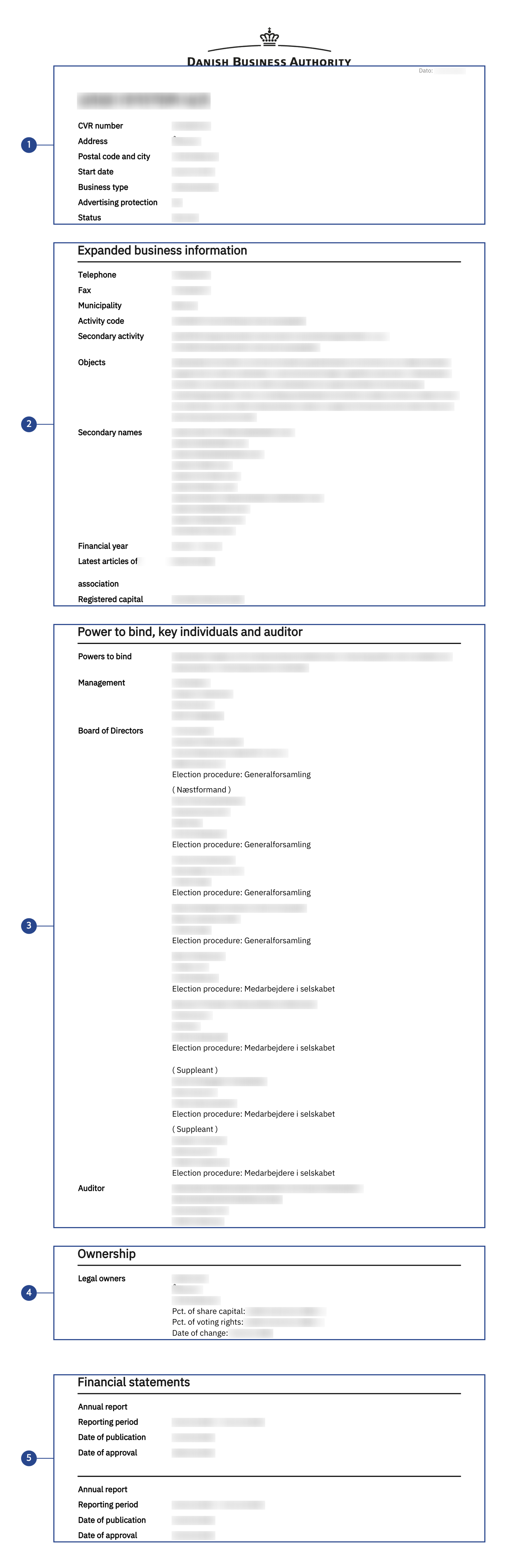
1. Company identification
The first block sets the core identity of the entity:
| Field | Description |
|---|---|
CVR number | The 8-digit unique company identifier |
Address / Postal code and city | Registered office address |
Start date | Date of incorporation or formation |
Business type | Legal form (Aktieselskab, Anpartsselskab, Partnerselskab, etc.) |
Status | Current registration status (e.g. Normal, Under afvikling) |
A flag indicates whether the entity has opted into Advertising protection (Reklamebeskyttelse), which restricts the marketing use of its contact information.
2. Expanded business information
Operational and statutory details, including:
- Telephone and fax numbers
- Municipality (Kommune)
- Primary activity code (Branchekode) with numeric code and description
- One or more secondary activity codes
- Corporate purpose (Formål) as registered in the articles of association
- Listed status (Yes/No), shown only where relevant
- Secondary names (Binavne) registered alongside the primary name
- Financial year (start and end dates, e.g. 01.01 – 31.12)
- Date of the most recent articles of association
- Classes of shares (e.g. A and B shares), where applicable
- Registered capital in DKK
3. Power to bind, key individuals, and auditor
This block describes signatory rules and governance:
- Powers to bind (Tegningsregel) — the rules for who can legally bind the company, written in free-form Danish (for example: chairman jointly with a vice-chairman, or a director jointly with a board member).
- Management (Direktion) — executive management, listing each member with title (Adm. dir. for CEO, Direktør for other directors), full name, and address.
- Board of Directors (Bestyrelse) — full board roster with role (Formand, Næstformand, Suppleant), name, address, and election procedure (general assembly elected vs. employee-elected representative).
- Auditor (Revisor) — the appointed audit firm with name and address.
- Sustainability auditor (Bæredygtighedsrevisor) — where applicable. This appears for listed companies subject to EU sustainability reporting requirements.
4. Ownership
The Legal owners (Legale ejere) section lists registered significant shareholders with:
- Owner name and address
- Percentage of share capital, often expressed in regulatory bands (e.g. 25–33.32%, 50–66.66%) or as an exact figure for wholly-owned subsidiaries
- Percentage of voting rights, expressed in the same bands
- Share class held (A, B, etc.) where multiple classes exist
- Date from which the current position applies
A Terminated legal owners subsection may also appear, listing former shareholders with the period they held the position and the disposal date.
5. Financial statements
A chronological list of all financial filings the company has made, including:
- Annual report (Årsrapport)
- Half-year report (Halvårsrapport)
- Interim report (Delårsrapport)
For each filing the document shows the reporting period, the date of publication, and, where applicable, the date of approval. Listed companies typically file quarterly or semi-annual interim reports alongside the annual report. The filing history can stretch back decades.
Entries for withdrawn or amended filings occasionally appear, indicating a correction or replacement.
6. Production units
Active Production units (Produktionsenheder) — the physical establishments where the company carries out its activities. Each unit is identified by its P-number and listed with name, address, start date, activity code, and advertising protection flag. Closed production units are listed separately with an additional cessation date.
7. Announcements
A table of public announcements filed by the company (for example Indkaldelse til generalforsamling — notices for general meetings), with the announcement date.
8. Registration history
The most extensive section: a chronological log of every change registered with the Erhvervsstyrelsen, written in Danish. Typical entry categories include:
- Ændring i personkreds — changes to board or management
- Ændring af kapital — share capital increases or reductions
- Ændring af adresse — address changes
- Ændring i revision — changes to the appointed auditor
- Statusændring — status changes such as mergers or demergers
- Øvrige ændringer — other changes (e.g. amendments to articles of association)
Each entry includes the date, the CVR number, the company name and address at the time, and a narrative description of the change.
9. Historical basic data
Structured tables showing how key data fields have evolved over the lifetime of the company: address history, activity codes, secondary activities, articles-of-association dates, registered capital amounts, powers to bind, and corporate objects.
10. Number of employees
Employee statistics are presented at two levels of granularity:
- Monthly figures (recent years) — headcount and full-time equivalents per month
- Quarterly figures (older periods) — expressed in bands (e.g. 100–199 employees, 1000+ full-time equivalents)
What is not included?
The Erhvervsudtog does not embed the actual financial statements. It lists the filings with reporting periods and publication dates; the underlying Årsrapporter are retrieved separately from the publication index.
It also does not display Reelle ejere (beneficial owners). UBO declarations are filed within the CVR alongside legal owners, but they are surfaced through a separate access path subject to the Danish Business Authority's eligibility rules.
With Topograph
Topograph orders the CVR Erhvervsudtog directly from the Erhvervsstyrelsen on demand. Each call returns the certified PDF together with the underlying CVR fields as structured data, so the document and the JSON company profile stay in sync. Delivery typically takes a couple of minutes from request to PDF.
---
Related articles
🇩🇰 Business Registers in Denmark: Det Centrale Virksomhedsregister (CVR)
Denmark's Det Centrale Virksomhedsregister (CVR) is a highly unified and publicly accessible register covering all Danish entities. Financial statements are filed and publicly accessible through the Erhvervsstyrelsen. CVR numbers are the primary identifier, and beneficial ownership was historically public before the 2022 CJEU ruling.
Read article