
What is the UBO Register Extract?
The UBO Register Extract is an official document issued by the SPF Finances — Trésorerie (Federal Public Service Finance — Treasury) in Belgium. It provides a structured overview of the beneficial owners (Ultimate Beneficial Owners) declared for a given Belgian legal entity. The register was established under the Belgian Anti-Money Laundering Law, transposing EU directives, and is maintained by the Treasury via the UBO register.
Belgian companies and other legal entities are legally required to register and keep up to date the identity of their beneficial owners. The UBO Extract is the printable output of this declaration and is widely used by compliance teams at financial institutions to verify beneficial ownership during KYC/KYB onboarding and periodic reviews.
The document carries an important disclaimer: it does not certify nor attest the accuracy or completeness of the information relating to UBOs. The data is declarative — it reflects what the entity itself has reported to the register.
What does it contain?
The UBO Extract is a two-page document with a consistent structure across all entities.
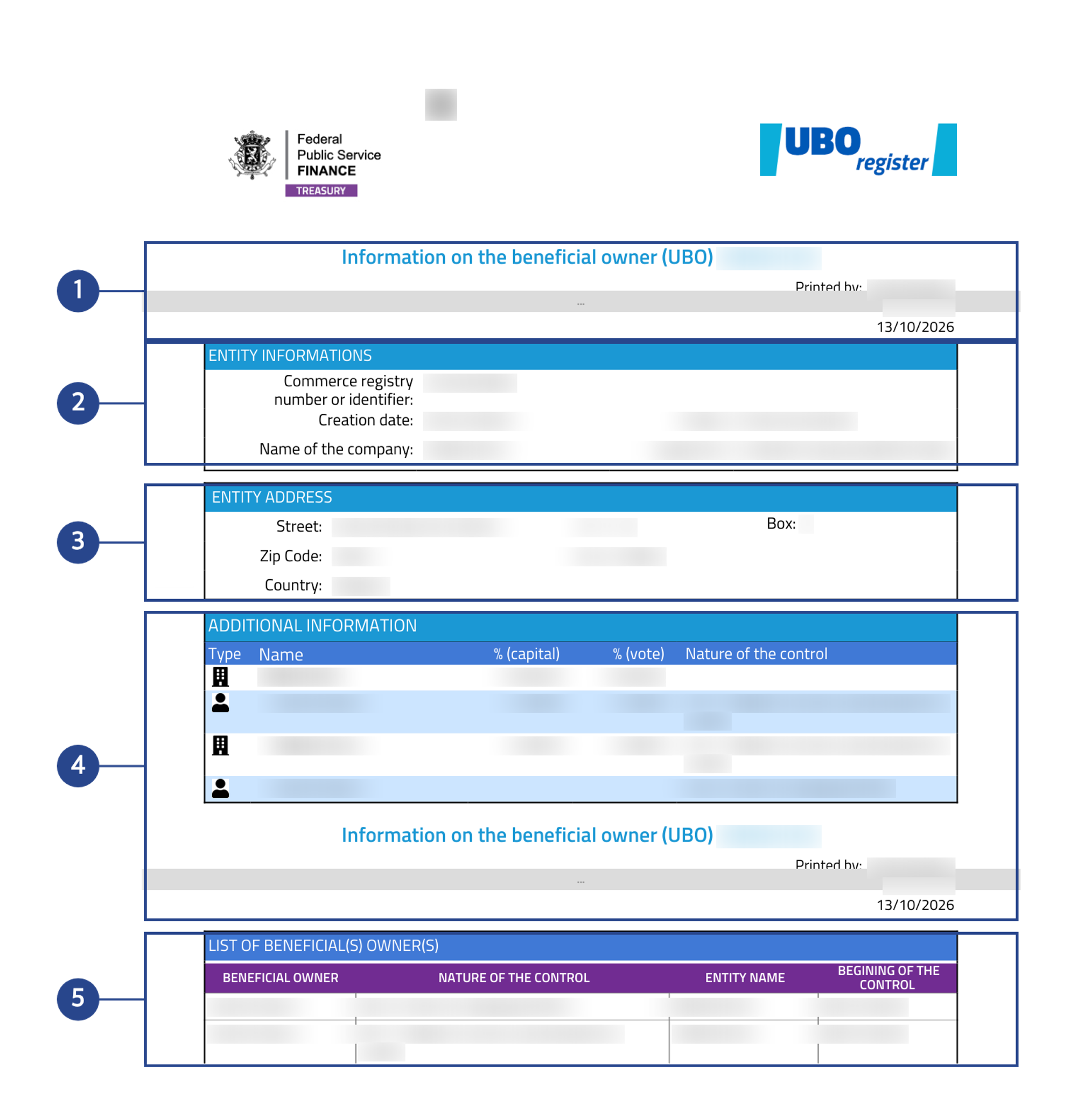
1. Header
- Federal Public Service Finance — Treasury logo and the UBO Register branding
- Document title: "Information on the beneficial owner (UBO)" followed by the company name
- Page numbering (e.g., Page 1/2)
- Printed by: Name of the person who generated the extract and the organisation they belong to
- Print date: The date the document was generated (e.g., 13/10/2026)
2. Entity Information
| Field | Description |
|---|---|
Commerce registry number or identifier | The company's BCE number (10-digit format) |
Creation date | Creation date of the entity, as shown on the extract |
Status | E.g., Normal situation |
Name of the company | Legal name of the entity |
Legal form | E.g., Société à responsabilité limitée |
3. Entity Address
The registered address of the entity, broken down into:
- Street, N° (number), Box (if applicable)
- Zip Code, City
- Country
4. Additional Information (Ownership Breakdown)
This is the core section of the document. It presents a table with the ownership and control structure, using icons to distinguish between types of entries:
| Column | Description |
|---|---|
Type | Icon indicating the type of row (legal entity, beneficial owner, other or group of beneficial owners), explained in the legend on page 2 |
Name | Name of the entity or individual |
% (capital) | Percentage of capital held |
% (vote) | Percentage of voting rights held |
Nature of the control | Category of control exercised |
The first row always represents the entity itself with 100% of capital and voting rights. Subsequent rows break down the ownership among beneficial owners and, where applicable, intermediate legal entities.
The nature of the control follows a standardised category system:
- Cat.1: Rights to vote or participation in capital
- Cat.2: Control by other means, such as a shareholders' agreement, a veto right or the power to appoint directors (none of the extracts we reviewed carried this category)
- Cat.3: Senior managing official, recorded when no one qualifies under the first two categories
A single individual can appear multiple times if they hold control through different categories (e.g., both as a capital holder and as a senior managing official).
5. List of Beneficial Owner(s)
The second page provides a detailed listing of each declared beneficial owner in a dedicated table:
| Column | Description |
|---|---|
Beneficial Owner | Full name of the natural person |
Nature of the Control | Category of control (e.g., Cat.1, Cat.3) |
Entity Name | The company to which the control relates |
Beginning of the Control | Date from which the control is effective |
This section also includes a legend explaining the four icon types used throughout the document: Legal entity, Beneficial owner, Other, and Group of beneficial owner.
6. Disclaimer
Each page carries a footer disclaimer stating: "This extract from the UBO Register contains the information available for the legal entity or arrangement it relates to. It does not certify nor attest the accuracy or completeness of the information relating to UBOs of the legal entity or structure concerned."
What is not included?
The UBO Extract does not contain personal identification details of the beneficial owners such as date of birth, national register number, nationality, or residential address. It is limited to names, control percentages, and the nature and start date of control. For full identification of UBOs, compliance teams will need to rely on complementary documents (e.g., identity documents, articles of association).
The extract also does not show whether the entity has confirmed its UBO information for the year, an annual obligation the register tracks.
With Topograph
Topograph enables automated retrieval and parsing of the Belgian UBO Register Extract. Key data points are structured and normalised, including:
- Beneficial owner names and control categories
- Capital and voting right percentages
- Start date of control
- Entity identification and legal form
This allows compliance teams to integrate Belgian UBO data directly into their onboarding workflows, cross-referencing it with other register sources such as the BCE Extract for a comprehensive KYB assessment.
Access to Belgian UBO data and the UBO extract through Topograph is limited to authorised entities.
Related articles
🇧🇪 Business Registers in Belgium: KBO, Moniteur Belge & NBB
Belgium's Crossroads Bank for Enterprises (KBO/BCE) is the central business register for all Belgian entities. Financial statements are filed with the National Bank of Belgium (NBB/BNB). Belgium's UBO register, managed by FPS Finance, retains broad public access for most entity types — one of the few EU registers to do so after the 2022 CJEU ruling.
Read article