
What are the Statuts?
The Statuts (articles of association) are the foundational constitutional document of a French company, because they define the company's legal framework, governance rules, and operating principles. They are drafted at the time of incorporation, signed by the founding shareholders, and filed as part of the company's registration; since 2023, filings are made through the unified guichet unique and recorded in the Registre National des Entreprises (RNE).
Although the Statuts are drafted privately, an updated copy must be filed each time they are amended, and the filed versions are publicly accessible. They are widely requested in KYC/KYB processes because they contain critical information about a company's identity, ownership structure, governance, and share transfer rules, and some of those details are not available on the Extrait Kbis or other register extracts.
Unlike a register extract, which provides a snapshot, the Statuts are a comprehensive legal text structured in numbered articles. They may be updated following shareholders' decisions (décisions des associés), and they are typically certified as conforming ("certifiés conformes") by the company's Président.
What do they contain?
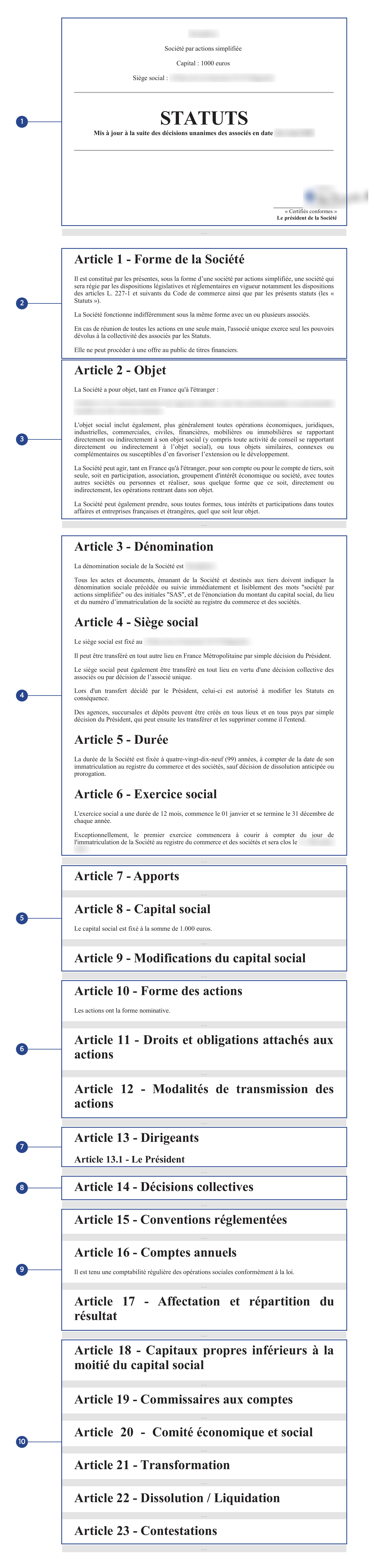
1. Cover page and certification
The Statuts open with a cover page stating the company name (dénomination sociale), legal form, share capital, and registered office address. The document is titled "STATUTS", and it indicates whether it has been updated, with reference to the date of the relevant shareholders' decision (e.g. "Mis à jour à la suite des décisions unanimes des associés en date du 6 mai 2025"). A certification statement ("Certifiés conformes") and the signature of the Président appear on this page, and electronic signatures (e.g. via DocuSign) are commonly used.
2. Legal form and governing law
Article 1 (Forme de la Société) specifies the legal form of the company, in the example a Société par actions simplifiée (SAS), and references the applicable provisions of the Code de commerce (Articles L. 227-1 et seq.). It also states whether the company may operate with one or more shareholders, and it confirms that the company cannot make a public offer of securities.
3. Corporate purpose
Article 2 (Objet) sets out the company's authorised business activities. This typically includes a specific primary activity (e.g. "l'édition et la commercialisation de logiciels") followed by broad ancillary language covering all related economic, financial, commercial, and advisory operations. This article matters for compliance professionals, because it lets you verify that the company's actual activities fall within its declared scope.
4. Company name, registered office, and duration
These core identification elements are spread across several articles:
| Article | Field | Description |
|---|---|---|
Article 3 – Dénomination | Company name | The official legal name of the company |
Article 4 – Siège social | Registered office | Full address, including rules for relocation |
Article 5 – Durée | Duration | Typically 99 years from registration |
Article 6 – Exercice social | Financial year | Start and end dates (e.g. 1 January to 31 December) |
The Statuts also specify who has the authority to transfer the registered office: typically the Président within metropolitan France, and the shareholders for any other location.
5. Capital structure and contributions
Article 7 (Apports) describes the initial contributions made by the founders: the total amount, the number of shares subscribed, the nominal value per share, and whether shares were fully paid up. It also identifies where the funds were deposited at incorporation, for example a notary's office or a bank.
Article 8 (Capital social) states the share capital amount, the total number of shares, and their par value. Compliance professionals should note that the capital figure and the number of shares in the Statuts may differ from the Kbis if the Statuts have been amended since the last register filing.
Article 9 (Modifications du capital social) outlines the conditions under which capital may be increased or reduced, including shareholders' preferential subscription rights (droit préférentiel de souscription).
6. Shares: form, rights, and transfer
Article 10 (Forme des actions) confirms that shares are in registered form (forme nominative) and recorded in accounts maintained by the company, and it mentions the possibility of creating preference shares (actions de préférence) with or without voting rights.
Article 11 (Droits et obligations attachés aux actions) describes the rights attached to each share: participation in profits, net assets, and liquidation surplus, proportional to the capital held. Each share confers one vote, and shareholders' liability is limited to their contributions.
Article 12 (Modalités de transmission des actions) sets out the rules governing share transfers. In the example, shares are freely transferable (librement cessibles et transmissibles), and transfer is effected by entry in the share transfer register (registre des mouvements de titres). Compliance professionals should pay close attention to this article, because many SAS statutes include approval clauses (clauses d'agrément) or pre-emption rights that restrict share transfers, so their absence here is noteworthy.
7. Management and governance
Article 13 (Dirigeants) is typically the longest section, and it defines the company's governance structure. In the example, it is divided into three sub-articles:
- Article 13.1 – Le Président: the Président may be a natural person or a legal entity, and need not be a shareholder. They are appointed by collective shareholder decision, and they hold the broadest powers to represent the company vis-à-vis third parties, within the limits of the corporate purpose. The article details appointment, term, resignation, and dismissal conditions.
- Article 13.2 – Directeurs Généraux et Directeurs Généraux Délégués: one or more Directeurs Généraux (general managers) or Directeurs Généraux Délégués (deputy general managers) may be appointed on the Président's proposal, and they hold the same powers as the Président to bind the company towards third parties.
- Article 13.3 – Le Comité Stratégique: this example includes a strategic committee of at least three members, appointed by shareholder majority vote. Certain "Important Decisions" (Décisions Importantes), listed in an annex, require the committee's prior approval, and the Comité Stratégique meets at least quarterly.
The presence or absence of governance bodies beyond the Président, and any limitations on management powers, vary significantly from one set of Statuts to another.
8. Shareholders' collective decisions
Article 14 (Décisions collectives) defines the scope of matters reserved for shareholder decision and the applicable voting rules. Key elements include:
- Simple majority decisions: approval of annual accounts, appointment and dismissal of officers, capital changes, mergers, and amendments to the Statuts
- Unanimous decisions: matters increasing shareholders' commitments, as required by Article L. 227-19 of the Code de commerce
Sub-articles detail the procedures for general meetings (assemblées générales), written consultations (consultation écrite), and decisions by private deed (acte sous seing privé), as well as shareholders' rights to prior information.
9. Regulated agreements, accounts, and profit allocation
- Article 15 – Conventions réglementées: related-party transactions must follow the control procedures prescribed by Article L. 227-10 of the Code de commerce.
- Article 16 – Comptes annuels: the Président prepares annual accounts for shareholder approval within six months of the financial year-end.
- Article 17 – Affectation et répartition du résultat: describes the mandatory 5% legal reserve allocation, conditions for dividend distribution, and treatment of losses.
10. Dissolution, liquidation, and miscellaneous provisions
The final articles cover:
- Article 18: obligations when equity falls below half the share capital (capitaux propres inférieurs à la moitié du capital social)
- Article 19: appointment conditions for statutory auditors (commissaires aux comptes)
- Article 20: the employee representation body (comité économique et social), where applicable
- Article 21: company transformation, requiring unanimous shareholder approval
- Article 22: dissolution and liquidation rules, including universal transfer of assets in the case of a sole corporate shareholder
- Article 23: jurisdiction for disputes (tribunaux compétents du siège social)
What is not included?
The Statuts typically do not contain:
- Shareholder identities or individual shareholdings: while the founding shareholders may be named in the contributions article or an annex, updated ownership information is not systematically reflected in amended Statuts, because the share register (registre des mouvements de titres) is a separate document
- Beneficial ownership data: UBO information is filed in the separate Registre des Bénéficiaires Effectifs (RBE)
- Personal details of officers: dates of birth, nationalities, and addresses of directors are not included in the body of the Statuts, since these appear on the Kbis and in appointment decisions
- Financial data: annual accounts are separate filings
With Topograph
Topograph gives compliance teams access to French company Statuts alongside other corporate documents through its API and web application. Through the platform, you can:
- Retrieve the Statuts as filed in the Registre National des Entreprises, with one document per filing, so the latest version reflects the current text
- Cross-reference Statuts data (capital, legal form, registered office) with the Extrait RNE and the Extrait Kbis for consistency checks
- Identify governance structures, share transfer restrictions, and management powers relevant to your KYC assessment
- Integrate document retrieval into your onboarding and ongoing due diligence workflows
This allows efficient verification of a company's constitutional framework without manual register searches.
---
Related articles
🇫🇷 Business Registers in France: Registre du Commerce et des Sociétés (RCS), RNE & RBE
France's company information system centers on the Registre du Commerce et des Sociétés (RCS), accessible through Infogreffe. The RNE, launched in January 2023, consolidates all business registrations at INPI. SIREN numbers are the primary identifier, issued by INSEE. UBO data is accessible to legitimate-interest holders.
Read article