
What is the Extrait RBE?
The Extrait RBE (Registre des Bénéficiaires Effectifs, the Register of Beneficial Owners) is the official beneficial ownership extract for entities registered in France. It is issued by the Institut National de la Propriété Industrielle (INPI) as part of the Registre National des Entreprises (RNE, the National Business Register), and it identifies the natural persons who ultimately own or control a company.
French entities are required to declare their beneficial owners, meaning the individuals who hold, directly or indirectly, more than 25% of the capital or voting rights, or who exercise control by any other means. The Extrait RBE provides a snapshot of those declarations as recorded in the register at a given date, and in KYC/KYB workflows it is the primary document used to verify the declared UBOs of a French entity.
The extract is delivered as the RNE Extrait des inscriptions carrying the beneficial-ownership inscriptions, so it opens with the company's register identity before detailing each declared owner. It carries both the République Française emblem and the INPI logo, together with a République Française watermark.
What does it contain?
The document opens with entity-level information for context, and it then devotes the bulk of its content to individual beneficial owner entries. Each owner's identity is followed by a detailed breakdown of how their control is exercised.
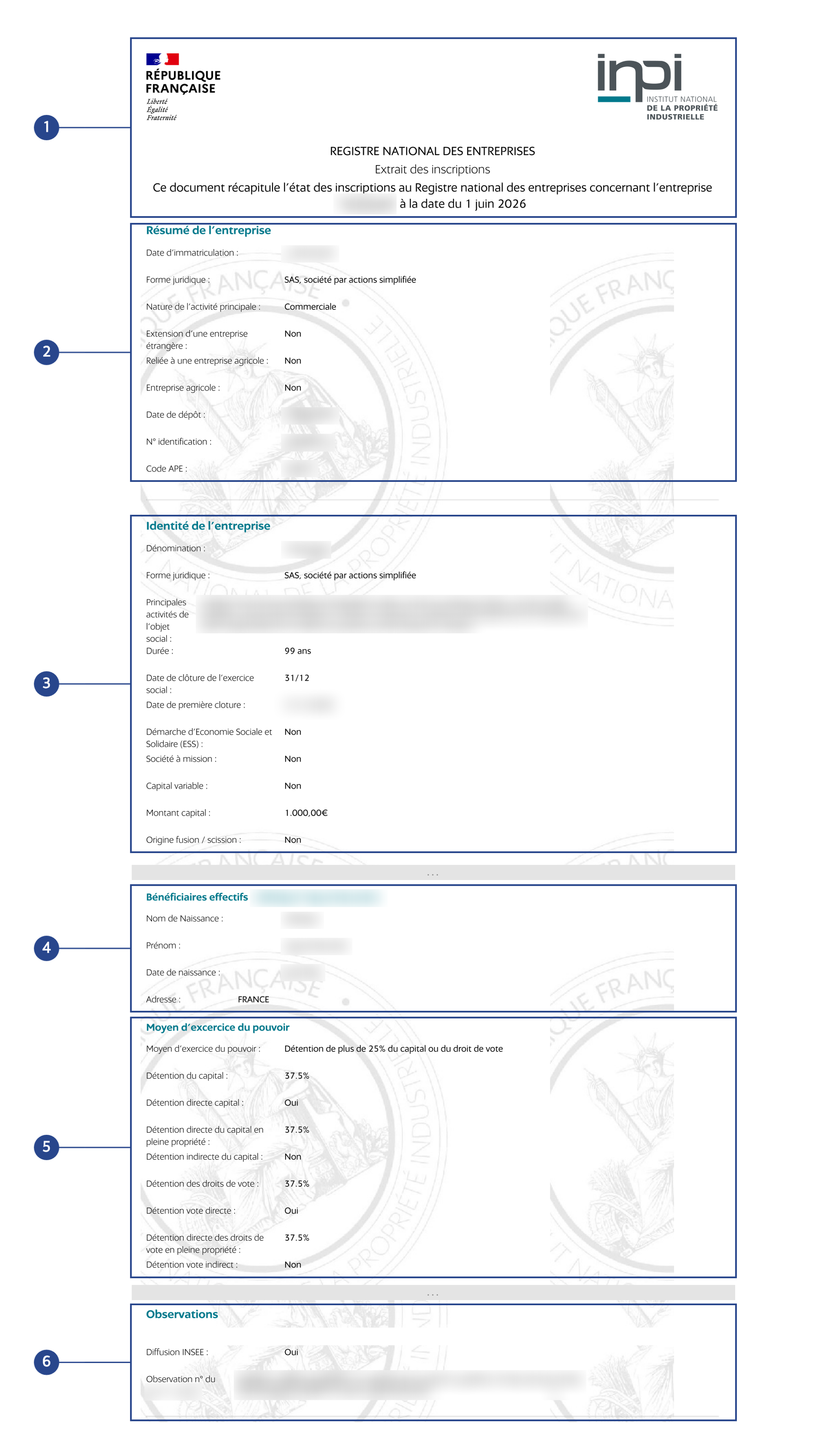
1. Document header and context
The header displays the République Française emblem and the INPI logo, followed by the title "Registre National des Entreprises, Extrait des inscriptions". An introductory line states the company name and the date at which the information is current (à la date du), confirming that this is a point-in-time snapshot.
2. Company summary
A section titled "Résumé de l'entreprise" provides key identifiers for the entity to which the beneficial ownership data relates:
| Field | Description |
|---|---|
Date d'immatriculation | Date of registration |
Forme juridique | Legal form (e.g. SAS, société par actions simplifiée) |
Nature de l'activité principale | Nature of principal activity (e.g. Commerciale) |
N° identification | Company identification number (SIREN) |
Code APE | Activity classification code assigned by INSEE |
Additional fields indicate whether the entity is an extension of a foreign company, linked to an agricultural business, or is itself an agricultural enterprise (all answered Oui/Non).
3. Entity identity
Under "Identité de l'entreprise", the extract repeats and expands on key corporate details:
- Dénomination: the legal name of the entity
- Forme juridique: the legal form
- Principales activités de l'objet social: a free-text description of the corporate purpose
- Durée: the statutory duration of the entity (typically 99 ans)
- Date de clôture de l'exercice social: financial year-end date
- Montant capital: share capital amount in Euros
- Capital variable: whether the entity has variable capital (Oui/Non)
Other flags include Société à mission (mission-driven company) and Démarche d'Economie Sociale et Solidaire (social and solidarity economy status).
4. Beneficial owner identity
Each beneficial owner is listed under a heading "Bénéficiaires effectifs" followed by the individual's full name. For each person, the extract provides:
| Field | Description |
|---|---|
Nom de Naissance | Birth surname |
Prénom | First name(s) |
Date de naissance | Date of birth (month/year only, e.g. 04/1993) |
Adresse | Country of residence (e.g. FRANCE) |
The date of birth is given as month and year only, because the exact day is not disclosed on the public extract, and the address field shows only the country rather than a full residential address.
5. Means of exercising control
Immediately below each beneficial owner's identity, a section titled "Moyen d'exercice du pouvoir" details how the individual exercises control over the entity, and the fields are granular:
| Field | Description |
|---|---|
Moyen d'exercice du pouvoir | Basis of control (e.g. "Détention de plus de 25% du capital ou du droit de vote") |
Détention du capital | Total percentage of capital held |
Détention directe capital | Whether capital is held directly (Oui/Non) |
Détention directe du capital en pleine propriété | Percentage of capital held directly in full ownership |
Détention indirecte du capital | Whether capital is held indirectly (Oui/Non) |
Détention des droits de vote | Total percentage of voting rights held |
Détention vote directe | Whether voting rights are held directly (Oui/Non) |
Détention directe des droits de vote en pleine propriété | Percentage of voting rights held directly in full ownership |
Détention vote indirect | Whether voting rights are held indirectly (Oui/Non) |
This structure distinguishes between capital ownership and voting rights, and within each, between direct and indirect holdings, as well as full ownership (pleine propriété) versus bare ownership or usufruct arrangements. And where multiple beneficial owners exist, the full identity and control blocks simply repeat for each person.
6. Observations
A final section titled "Observations" may contain administrative notes. In the example, it records an INSEE diffusion flag (Diffusion INSEE: Oui) and a dated observation noting the entity's de-registration following a jurisdictional transfer (Radiation d'office par suite du transfert). These entries are referenced by date, so they provide an audit trail of significant register events.
What is not included?
The public Extrait RBE does not disclose the full date of birth, because only the month and year are shown, and the address field is limited to the country of residence with no street-level address. The extract also carries no information on directors, registered office details, corporate activity descriptions, or financial data beyond the summary sections, since those belong to the broader company extract and other RNE filings. There is no QR code or verification code for online authentication of the document.
Also note that companies whose securities are listed on a regulated market are exempt from beneficial ownership declarations, so the register can legitimately return no beneficial owners for them.
With Topograph
Topograph retrieves Extrait RBE beneficial ownership extracts for French entities as part of your KYC/KYB workflows. You can:
- Retrieve the official list of beneficial owners for any French company registered with the RNE
- Get structured data including ownership percentages, voting rights, and the direct or indirect nature of holdings
- Connect your own INPI account to receive the register's richer, un-redacted version of the extract, with full personal details of each beneficial owner
- Cross-reference RBE data with the Extrait Kbis and the Extrait RNE to build a complete corporate profile covering both legal representatives and ultimate beneficial owners
And because Topograph parses the extract into structured, machine-readable data, beneficial ownership verification integrates directly into automated compliance pipelines.
---
Related articles
🇫🇷 Business Registers in France: Registre du Commerce et des Sociétés (RCS), RNE & RBE
France's company information system centers on the Registre du Commerce et des Sociétés (RCS), accessible through Infogreffe. The RNE, launched in January 2023, consolidates all business registrations at INPI. SIREN numbers are the primary identifier, issued by INSEE. UBO data is accessible to legitimate-interest holders.
Read article